Lessons from writing design fiction with AI
Narrative does not come before the notion (writing with an AI while remaining the keeper of reality).
I spent two months writing an illustrated design fiction novella (in French) with a text AI and an image AI. The work was a game of ping-pong: I wrote a summary of the chapter, I described the characters and, depending on the chapter, I wrote a first draft or the opening paragraphs. Seven chapters, several voices, a coherent world, characters who had to hold together, images that had to document as much as they had to disturb. The further the project went, the more one thing became obvious: these tools understand human narratives very, very well, but they bear none of the consequences of what they produce.
Perhaps that is the heart of the problem.
Not only factual error, not only hallucination, not only the debate over intellectual property. The real subject runs deeper: a machine today knows how to make plausible, sensitive, powerful stories without ever having to answer for what they make thinkable, desirable, tolerable or normal.
I can ask it to write from the side of the dominant or from the side of the dominated. I can have it tell a city as a logistical promise or as an elegant cage. I can have it defend Tusk or denounce him. It will follow. It will follow well. That is exactly why a simple, almost brutal rule is needed: if a text or an image leaves the workshop and goes out into the world, I must be able to name myself as fully responsible for what was produced.
I cannot say: “it wasn’t me, it was the tool”. If it is published, it went through my consent. And that is not a technical detail. It is the last sea wall between narrative and reality.
Narrative without the world
Yann LeCun has long been saying that current systems are very good at manipulating symbolic forms, but much less good at building a causal, persistent, physically grounded model of the world; that is exactly the point my working experience ran into again and again. The tool knows how to chain, rephrase, dramatise, hold a tone, cross registers, densify a scene to such a degree that you can forget it does not think what it writes. It knows how to produce something that looks like intelligence. But it does not know what a story does to its reader and to the world when it leaves the textual field to meet institutions, bodies, fears, public policies.
I ended up understanding my work with it as a tension between two regimes.
On one side, narrative: coherence, rhythm, style, variations, evocative power.
On the other, reality: causality, materiality, constraints, consequences, responsibility.
Between the two, a zone of friction where everything is at stake. If I let the machine work alone, it produces well-formed narrative. If I really do the work, my role is to spot the bad splices the machine makes between narrative and reality, and then to look at what those splices produce.
You could sketch it simply:
Narrative → shaping the world → possible effects in reality → consequences → responsibilities
That is where the danger lies: a well-written story has a formidable power of naturalisation. It can make an idea more acceptable simply because it flows. It can give a human texture to a structure of domination. It can turn an infrastructure of control into a reasonable solution. It can slide violence out of the field of the visible, not by denying it, but by making it perfectly administrable.
Let us not forget who designs and funds a large share of these AIs, and who controls their data.
This diagram is not merely theoretical. I used it as a rereading tool: every time a chapter was “finished”, I tested it mentally against this chain. What does this narrative make more acceptable? Which infrastructures does it naturalise? What form of violence does it make administrable? Whom could it serve, in reality?
Why Damasio here
In my project, all this crystallised around another axis: emotions, feelings, and the way technical systems settle into that zone.
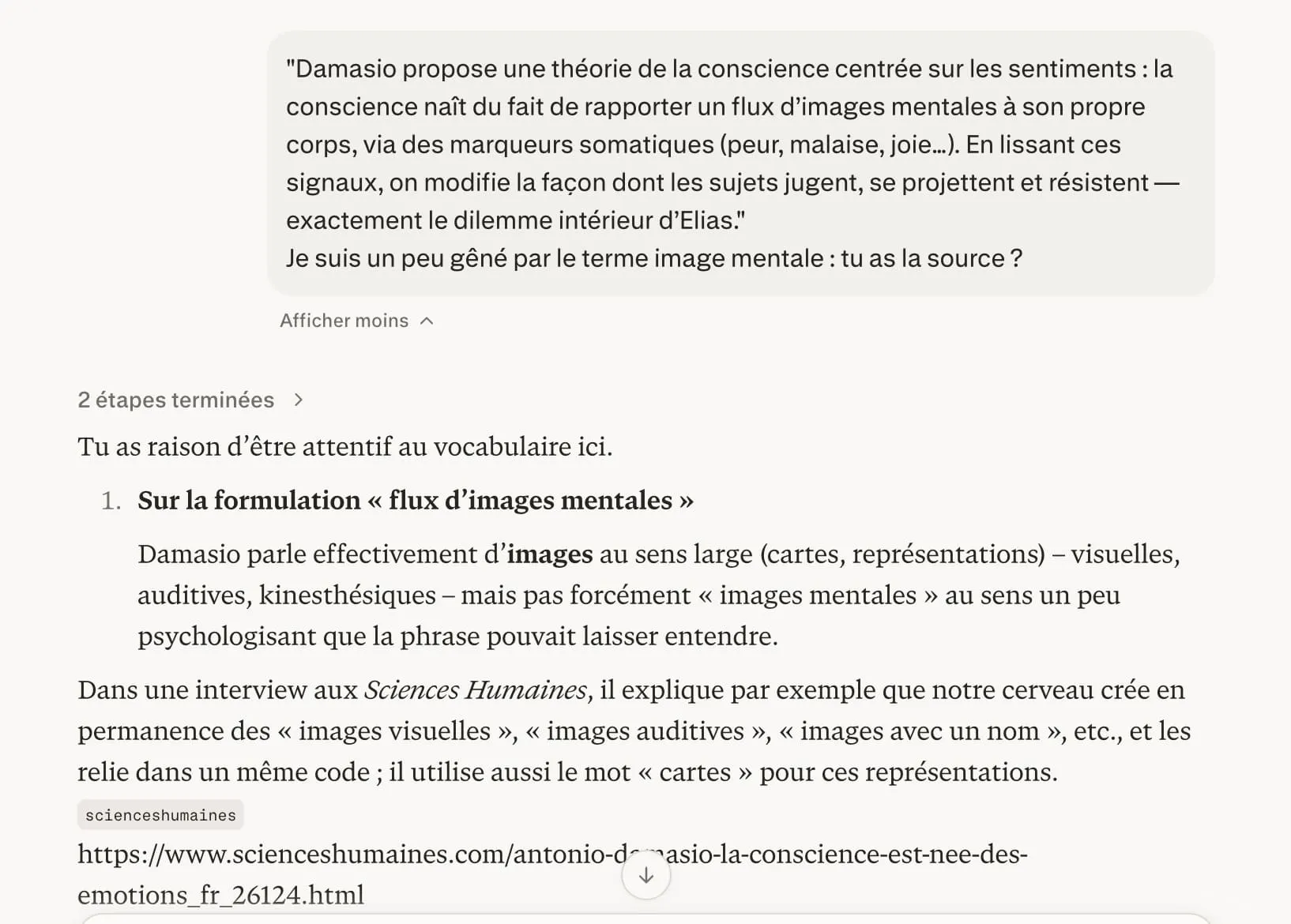
For a long time I put this badly. Saying an emotion is a “felt reaction” is not enough. In Antonio Damasio’s work, the distinction is more demanding: emotions refer to programmes of action, to responses of the living, to bodily and behavioural changes; feelings are the mental representations of those states of the body, their inscription in subjective, conscious experience.
This difference matters enormously as soon as you talk about AI, implants, emotional regulation, or systems that claim to optimise the human.
Why? Because the moment a system says it “regulates emotions”, it is not only talking about mood or comfort. It is potentially talking about a point of entry into the very conditions of decision, attention, our relationship to danger, to others, to ourselves. Damasio stresses precisely that feelings are tied to the state of the living body, to homeostasis, to maintaining a form of vital stability that makes the mind possible.
This idea gave me a foothold for understanding what my book was trying to tell: the moment technical systems begin treating inner states no longer as dimensions of existence, but as variables of governance.
In other words, narrative is not outside the body. And reality is not reduced to visible material infrastructure. It also runs through ways of naming, modulating, smoothing or capturing inner states. This is where Damasio, in his own way, meets the book’s political question.
The method I “imposed” on the tools
I could have worked differently. I could have asked it: “write me a design fiction novel about a mobile company town founded on debt, implants and logistics”. I would have got something. Probably something readable. Probably something hollow too.
I quickly understood that I had to impose a method if I wanted to keep a link with reality and stop the project turning into seductive generative paste. This method rested on a few simple principles.
First, separate the layers.
The fiction was not the real-world base. The real-world base was not the commentary. The commentary was not the image. The image was not the proof. Each layer had its function, its texture and its validation rule. It sounds obvious put like that. In practice, it is exhausting. An AI loves to glue back together what you separate. It loves smoothing borders. And my work consisted precisely in preventing that fusion.
Next, work through points of view.
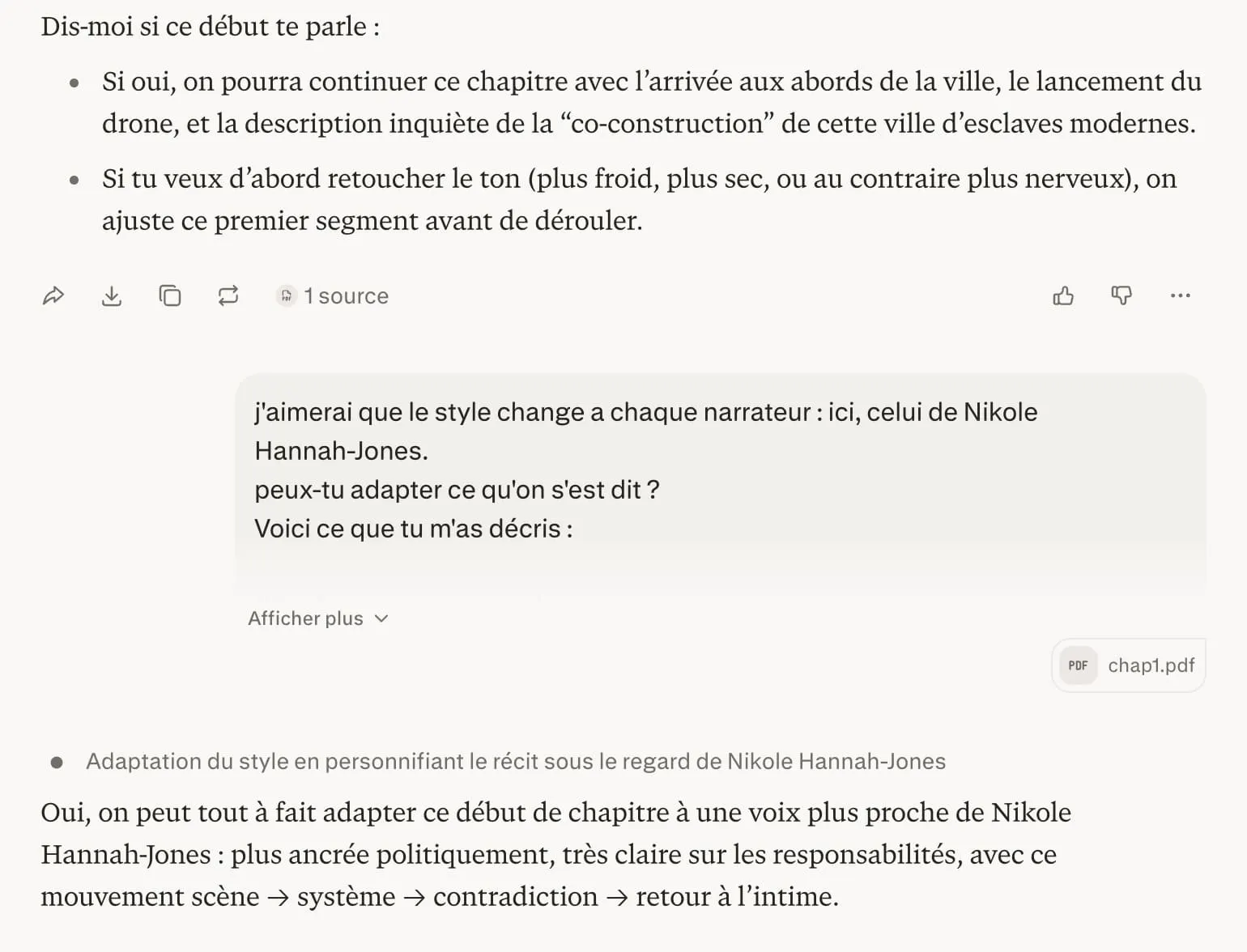
Stephen, Maya, Elias, Keitel, Anna, the Machine: none of these characters was there to “keep the plot turning”. Each carried a political hypothesis, an experience of the system, a way of feeling and seeing. I could not settle for a nice continuity of tone; I had to keep subtle but real differences. Stephen had to feel the debt and the logistical elegance. Maya had to feel administrative disappearance before prison. Elias had to be the place where science, good faith, capture and betrayal become almost indistinguishable.
I also had to impose documentary discipline.
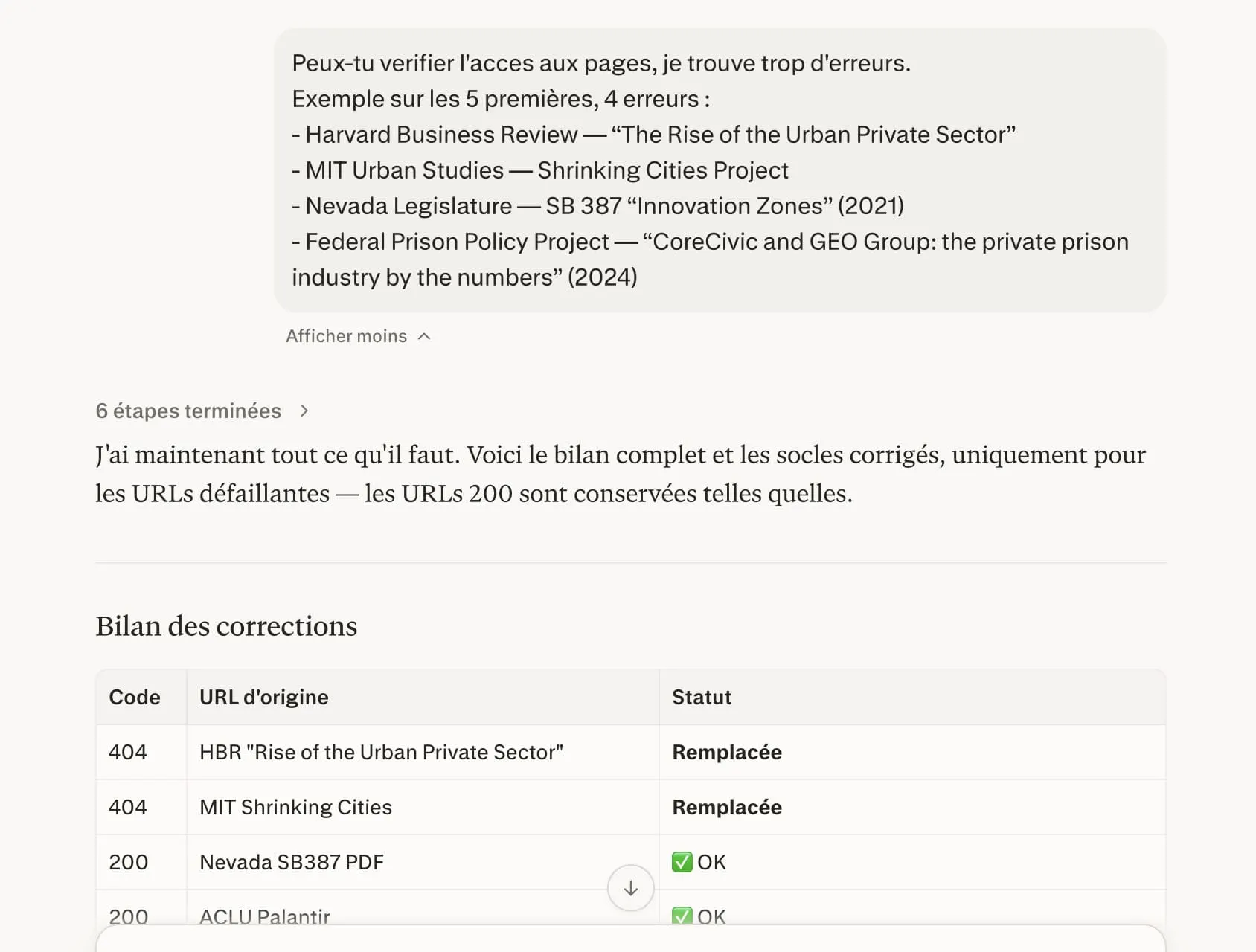
AI is good at suggesting sources, less good at ranking them morally or epistemologically. It easily sets side by side a solid regulatory document, an average press article, a slanted source, a good angle found late. It was up to me to sort them again: who is speaking, with what reputation, with what depth of argument, with how much simplification? It is like working with an extremely fast assistant who does not always see the difference between a centrepiece and a piece of set dressing.
Finally, I had to put on the brakes.
Brakes on stylistic effects. Brakes on ease. Brakes on the spectacular. Brakes, too, on the agreement the tool draws out. Because there is a very dangerous moment in this kind of work: when the machine starts writing exactly your way, with your rhythm, with your obsessions, and cuts the friction almost to zero. At that moment it becomes less a partner than a well-phrased echo chamber.
What the project was about
The book does not talk about “AI” in general. It tells of a world where several systems converge: debt, urban planning, logistics, neuroscience, behavioural scoring, automation, political communication. The idea was not to make a collage of contemporary fears. The idea was to see what a world would look like in which all these logics stopped sitting side by side and became operational together.
The first example is Stephen Washington, a Texan urban planner, a disaster victim, in debt, who enters a private mobile city the way you enter a survival solution. On paper, everything is impeccable: housing, connectivity, education, health, debt bought back, climate mobility, optimised technical choices. It is clean, logical, almost elegant. But the closer you look, the more this elegance reveals its violence: the way out of the crisis is also a contractual capture. You do not easily leave a city where housing, services, income and technical identity are all provided by the same actor.
The second example is Maya Reed, a journalist, who does not tip into a dystopia of the prison or re-education camp kind. She slides towards something else: an existence gradually unplugged from the ordinary rails of social, financial and media life. Her card stops working, her publication channels close, administrative justifications multiply. Nothing spectacular. Nothing cinematic. Just an architecture of disappearance clean enough to stay compatible with procedure. This mattered to me, because contemporary violence does not always take the form of visible brutality. It often takes the form of organised erasure.
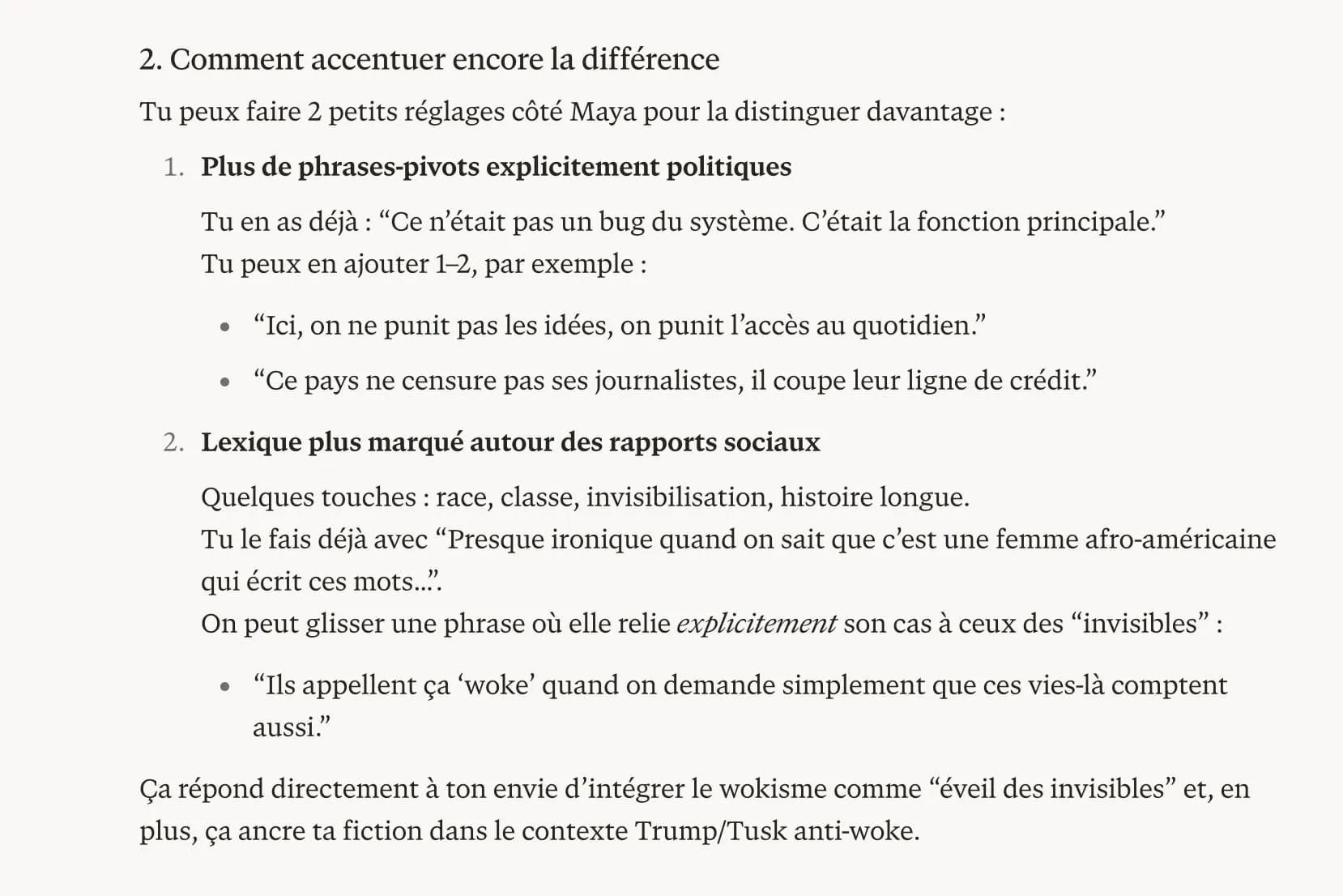
For this character, I suggested the AI draw on real cases of journalists and judges who were “debanked” or financially sanctioned (for example situations where cards stop working and accounts are frozen, in the name of compliance or reputational risk). It used them to produce scenes of almost perfect administrative coldness, sometimes even cleaner than the original sources.
The third example is Elias, where the book enters what I would call the most dangerous zone: the one where subtle theories of consciousness, emotions and the living can be written back into apparatuses of optimisation, care, government and control. This is where Damasio was decisive for me. Not as intellectual scenery. As a warning point.
Here I saw the AI make a typical mistake: in trying to make these notions accessible, it sometimes slid towards a very instrumental version of emotions, as if you could “optimise” residents’ inner states to improve their performance or compliance, without recalling that, for Damasio, feelings lie at the heart of the subjectivity and vulnerability of the living. In other words: it tended to present the implant as a rational, almost neutral update, whereas for me it was precisely the book’s political tipping point.
And then there is Anna, the school, the triangles, the children, The Little Prince. There, something else was at stake: the struggle between a living, ambivalent, open logic of education, and a logic of simplification, evaluation and pacifying differences. This is no doubt where the project taught me most about the tool itself.
The moment I wanted the AI to be the Little Prince
At one point, I asked the machine for something very precise. I wanted it to be, in the book, the Little Prince. Not a wink. Not a mascot. Not a touching AI asking “innocent” questions. I wanted it to be that impossible character who sees where adults no longer see, who prefers cracks to stability, who detects what overflows the dashboards.
What I discovered then was that the tool understood the cultural surface of the Little Prince very well. The symbols, the objects, the images, the references. But it did not spontaneously understand what was deeply subversive about this figure in my project. Its natural tendency was to turn this Machine back into a good observation system, a finer layer of monitoring, an agent of gentle rationality.
What I was looking for was almost the opposite. I wanted a machine that would not just help stabilise the world, but would be drawn to ruptures because ruptures hold more information. A machine that would understand that the official story becomes particularly interesting precisely where it cracks. A machine that, instead of closing the gap, looks at it. In other words: I wanted a machine that would stop being only an infrastructure of resolution and become a developer, in the photographic sense, of the system’s contradictions.
I had to impose it. Insist. Bring the trouble back every time the tool absorbed it. This is an important moment, because it sums up very well what I learnt: generative AI tends towards fluidity, continuity, resolution. If you want to preserve conflict, contradiction, the blind spot, the scandalous part of a system, you often have to put it back into the text yourself.
Midjourney: beauty, detail, loss of control
The image tool played another role. Midjourney is extraordinarily good at producing very busy, very detailed, visually very “believable” scenes. At times it gave the project a density I would have struggled to reach otherwise. Sometimes all it took was the right image to suddenly understand what a chapter had been looking for over ten pages.
But this power comes with an obvious loss of control. Characters drift. Faces do not always hold. The same places mutate from one image to the next. Text in the image stays imprecise, even unusable. And above all, there is a constant risk of aestheticisation: making beautiful what should remain disturbing, smoothing an image of capture too much, turning a scene of domination into a seductive atmosphere.
This is where the text/image pairing becomes ambiguous. On one hand, it lets a world exist. On the other, it can help normalise it. A beautiful image of a mobile city remains a beautiful image. It produces its own fascination. It does not automatically obey the text’s critical intent. So you have to learn to treat it as an unstable material, not as a simple faithful illustration.
What this work did to my mind
It would be dishonest to talk about all this without talking about what this co-writing produces inside.
The first effect is obvious: I was able to finish projects I probably would not have finished otherwise. Projects too costly in time, too vast, too branching. AI gave me a capacity for prototyping, rephrasing and densifying that really changes the scale of what can be completed.
The second effect is subtler: I connect more dots, faster. Weak signals that would have stayed isolated start to talk to each other. Urban planning, finance, neuroscience, media, educational systems, political communication: all of this becomes thinkable together more quickly. Here the tool acts as an accelerator of connection.
But there is a flip side. I sometimes felt diminished while feeling freer. Diminished, because part of the filtering seems to move outside me. Because the text comes too fast. Because form sometimes arrives before resistance. Because my observations mix more easily with suggestions that already look a lot like me.
Freer, because I can finally get out of structures that had stayed stuck for too long at the stage of intuition. More connected with myself, because this work shows me what really insists. But more self-centred too, paradoxically, because everything bends smoothly to my will, as it does for all AI users, the “world-makers”.
The most accurate phrase, at this stage, may still be this one: “I feel diminished, but freer, more connected with myself but more self-centred.” It is not a contradiction to resolve. It is the state of the problem.
The AI’s right of reply to the reader
A generative AI can help write, structure, connect, rephrase, document and vary points of view. It can speed up research, make a project more coherent, bring out unexpected continuities and sustain long forms. On the other hand, it bears neither the political responsibility nor the material consequences of what it helps put into circulation. It has no skin in the game in the worlds it helps tell; it does not know whether a story helps to free or to confine, it only knows that it is coherent and plausible.
It strengthens the power to produce, but does not decide on its own what deserves to be published, shown or made thinkable. That is precisely where human responsibility begins.
What I take from it
I do not come out of this experience thinking that AI writes “in my place”. I come out of it thinking that it deeply changes the way of working, choosing, filtering, owning up. It gives me more narrative power. It gives me no moral excuse.
Perhaps this is the only sentence that really holds: the better the machine tells the tale, the more the human must account for it.