Building your own framework
Choreographing growth through collective design
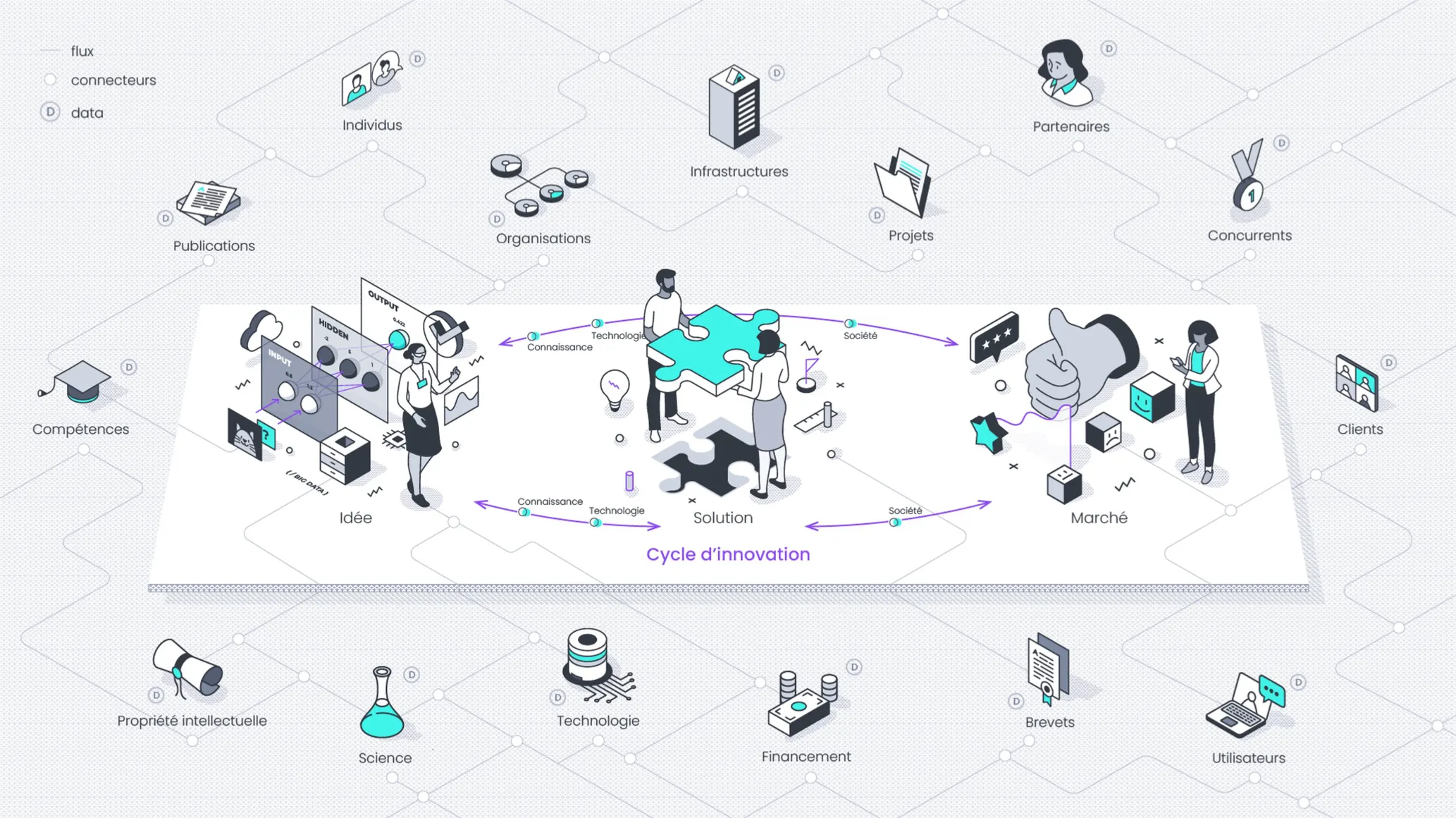
Isometric infographic showing the innovation cycle, from idea to market, using a systemic AI matrix.
In my white paper Itinéraires Design, I define design as work on the conditions of cooperation, where the designer acts as a cartographer and a choreographer of complexity. This use case shows how to turn a linear roadmap into a living route map to structure an organisation’s growth.
1. The mandate: structuring the scale-up
In 2021, as Head of Design, I supported a start-up whose core product was a complex AI matrix. It was not a simple algorithm, but a systemic crossroads able to connect innovation projects to a whole environment: investment theses, patents, experts, legal context, strategic partners, …
The challenge was to support the scale-up (from 25 to 50 people) of this start-up, which had won a new tender from the European Innovation Council. My mandate here was not about transforming the product itself, but about structuring the organisation to carry this expansion. The aim was to align the disciplines and the AI in a shared operating model.
2. Pre-scoping: turning expertise into a concept
For disruptive projects like these, design cannot be “peripheral”. We had to build a pre-scoping phase into the framework to “design the concept” before the product, and to link business need with data/AI feasibility. The Product Owner, an innovation specialist and “keeper of the matrix”, would carry the raw ideas.
My strategic role was to organise the workshops needed to connect this PO with design. I also tasked designers and user researchers with running the interviews and exploration phases essential to turning these business ideas into actionable product concepts.
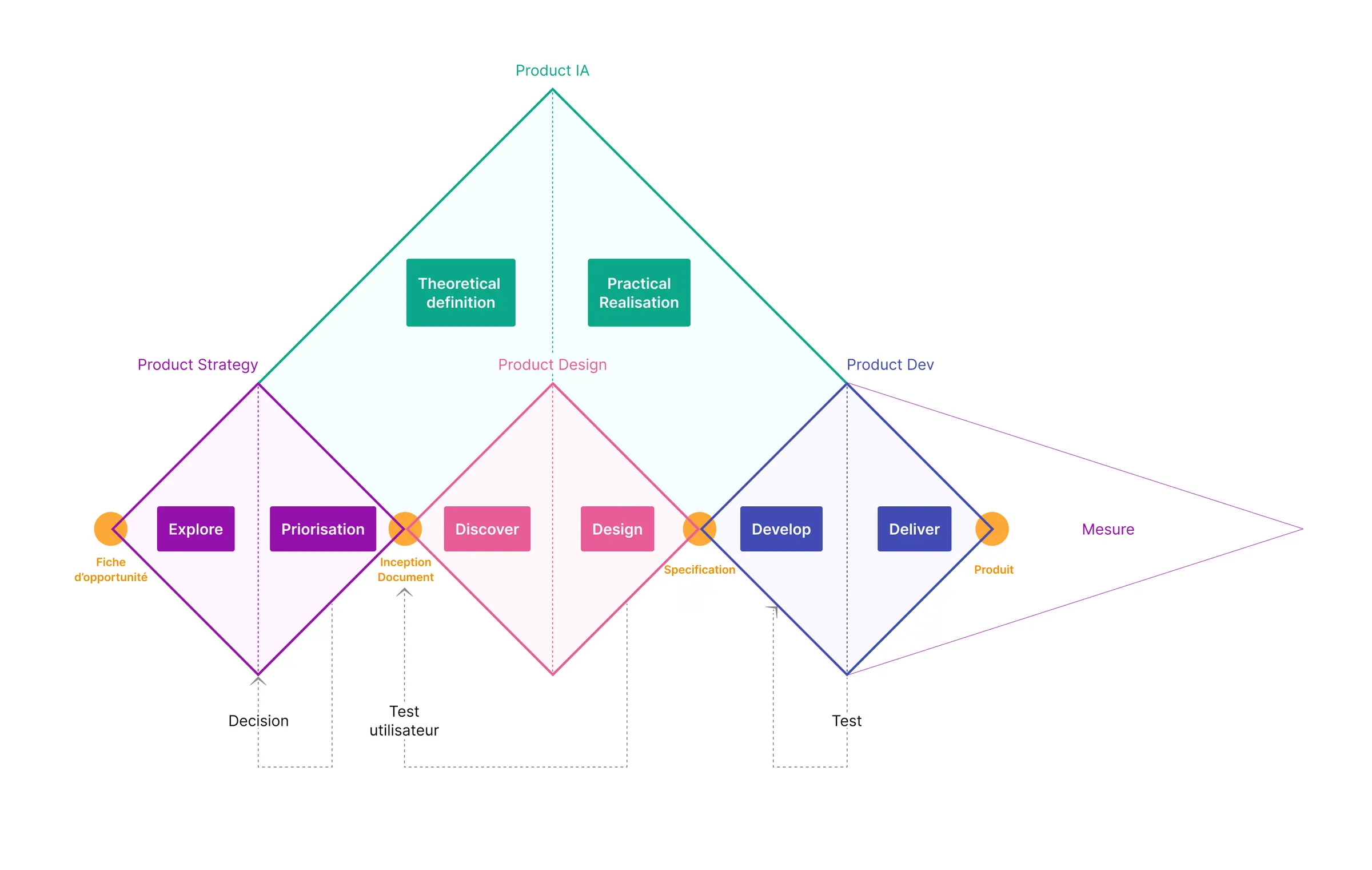
A framework based on the double diamond, adapted to the context of a start-up working on innovative products built on an in-house AI.
3. The choreography: lucidity and co-construction
A 2-day sprint. The whole international team was brought together in person to turn a sequence of work into a genuine route map.
How it unfolded
- Day 1, plenary then ambassadors: after a talk by the CEO on the meaning of the project, I ran the presentation of the user circles. By identifying blind spots and friction live, the collective developed the systemic lucidity needed to see the map.
In the afternoon, the ambassadors presented their respective frameworks to one another so that each could take ownership of the others’ constraints. Each team (data, innovation, dev, design) had a lead who had worked on their part of the framework from the matrix I had proposed. - Day 2, wider circle then plenary: in the wider circle, I used an approach of reverse-engineering success. We listed the problems met on a typical project to define solutions to test. These solutions were added to the framework. The ambassadors then presented the complete workflow in plenary to all the client-facing teams.
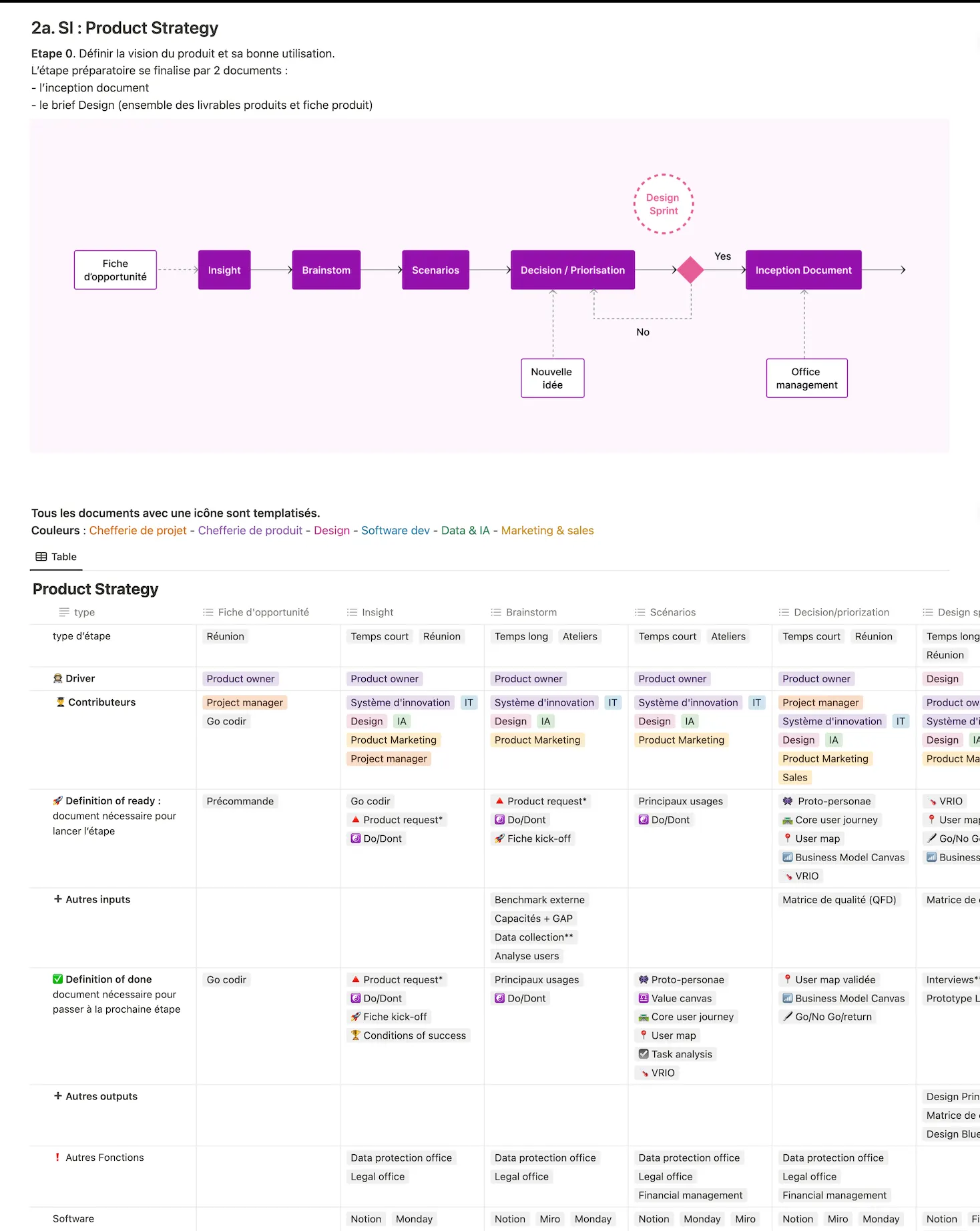
Detail of the framework on the first added diamond, first step.
4. Delivery and regulation: securing the route
The main co-built deliverable is the operational framework and its playbook in Notion, bringing together the essential rules and the mandatory templates. It does not stop at standard digital production (the design of “peripheral functions”), but formally writes innovation and data into the delivery flow.
- The “Innovation” route (pre-scoping)\
- The “Data” route (R&D synchronisation): the framework resolves the friction between the long timescales of AI research and the short cycles of product. It formalises a specific flow (Business Understanding, Data Acquisition, Scenario Specification) that feeds the standard design flow.
To handle friction (such as last-minute scope changes), we activated regulation plates:
- Contract management (a detailed SOW) to set the frame and limit revisions.\
- The Inception Document as a shared container for innovation and standard changes, used to officially start “design & development”.\
- A management platform that blocks the move to the next step without formal validation.
5. Into the field: industrialisation and training
To move from “saying” to “doing”, the set-up included a strict operational strand:
- The Design Hub & Playbook: by day 10, the whole workflow and the mandatory templates (including the Definition of Ready/Done passage criteria) were available in Notion.
- Complete documentation and glossary.
- AI training: the first post-sprint session was a training by our AI specialists, so that the whole collective would understand the technical constraints and the long timescales of R&D, and better synchronise them with product cycles.
Conclusion: the legacy of the step climbed
For 18 months, this framework allowed a cross-disciplinary collective to “climb the step” of a complex subject. Design acted here as work on the conditions of cooperation. By turning the roadmap into a route map, I helped the collective picture its project as an object and accept what it was giving up, so as to choose its routes in full lucidity.
Coming next in this series of use cases: the user circle, the interface list, the usability audit.