Portfolio · Strategy & Operations
Choreographing complex growth
Between disruptive innovation and the rigour of agile delivery.
- Role
- Head of Design
- Client
- The Innovation Loop (TIL)
- Deliverables
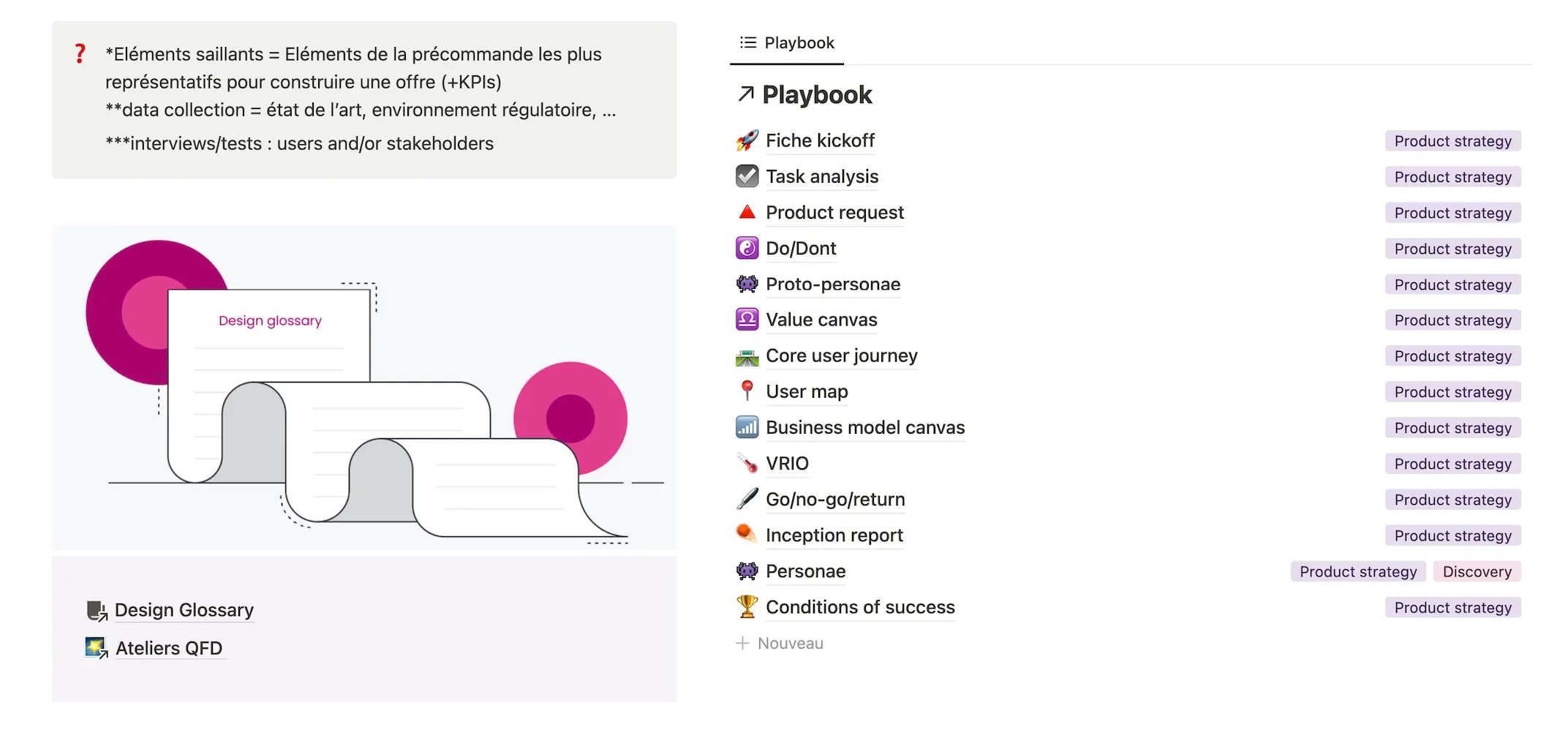
- Working method documented in Notion (including the AI part), playbook of templates and workshops, DACI matrix
- Period
- 2022-2023
- Context
- A startup that had just won a €12M contract with the European Commission (EIC)
The intent
Winning a €12 million contract from the European Innovation Council acted as a catalyst of absolute urgency for The Innovation Loop. Suddenly the challenge was no longer only to perfect a complex AI matrix, but to pull off a lightning scale-up, doubling headcount from 25 to 50 in record time. This win carried a systemic pressure: how do you absorb such growth without the structure collapsing under its own weight?
In this context of imminent scale-up, my mission as Head of Design was to stabilise the foundations before even thinking about adding floors to production. It was essential not to settle for a linear roadmap but to design a genuine route map to orchestrate cooperation. Without a solid working frame (a documented operational framework), the startup risked spreading itself thin designing “peripheral functions” instead of acting on its deep structure.
My role was that of the designer who “weaves the links” between two cultures often seen as opposites: disruptive innovation, carried by slow-paced R&D, and agile delivery, which demands short cycles. I had to connect souls with roles by running strategic workshops to align the C-suite and the operational teams. The same work had to be done for the AI team, which needed to make its natural working rhythms understood. By turning this organic growth problem into an opportunity for an exemplary structure, we were able to co-build a playbook in Notion, including governance rules and entry and exit criteria (Definition of Done / Ready). This choreography let the collective “take the step up” lucidly, proving that design is the essential engine of coherence in a system in full expansion.
The mechanics
The challenges
- Linking two cultures: making strategic innovation (long cycles) and agile delivery (short cycles) live together.
- Organising the collective: creating a working frame that 26 colleagues would sign up to.
- Identifying the functions: mapping the professions to spot the functions not covered in the production chain.
- Documenting for onboarding: creating a source of truth to welcome newcomers effectively.
The plan
Building the framework followed a sprint mastering protocol:
- Preparation (4 days): working with managers and ambassadors to prepare the key steps.
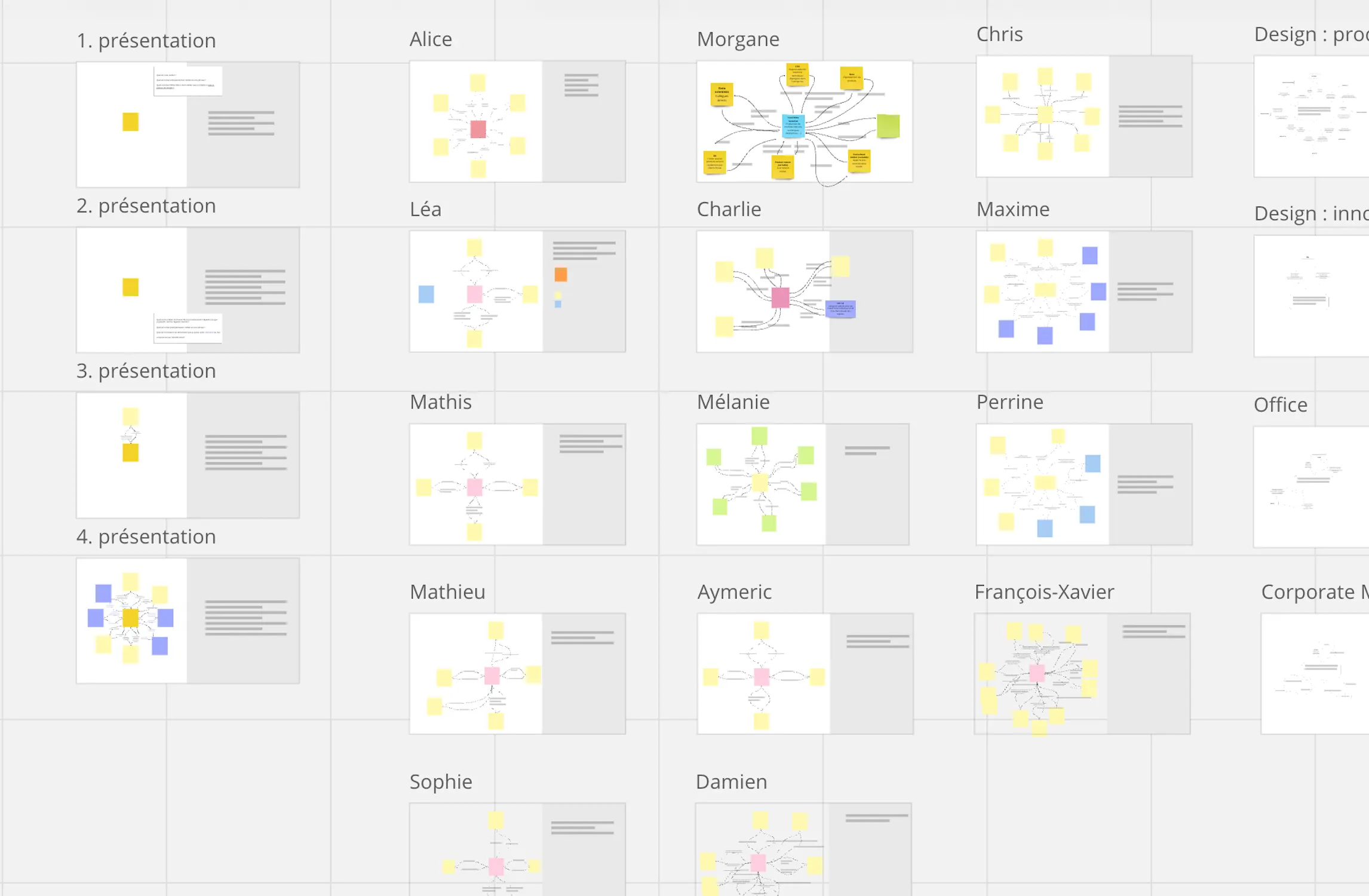
- The collective sprint (3 days): running workshops with all 26 colleagues to validate the workflows together.
- The user circle: using this workshop as an ice-breaker to define who owes what to whom at each step.
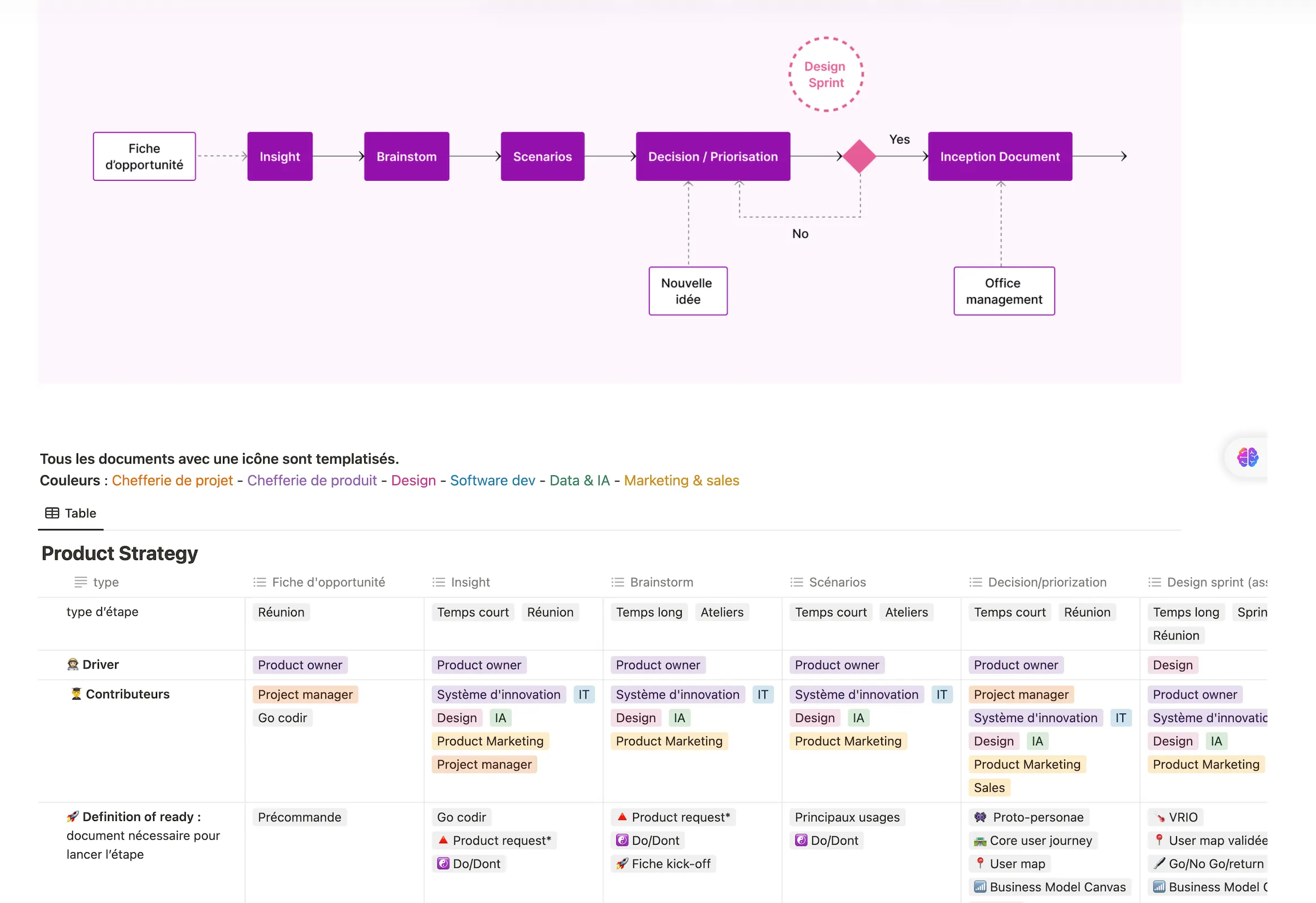
- Finalisation (8 days): full documentation in Notion, including the Definition of Ready and Definition of Done for each phase.
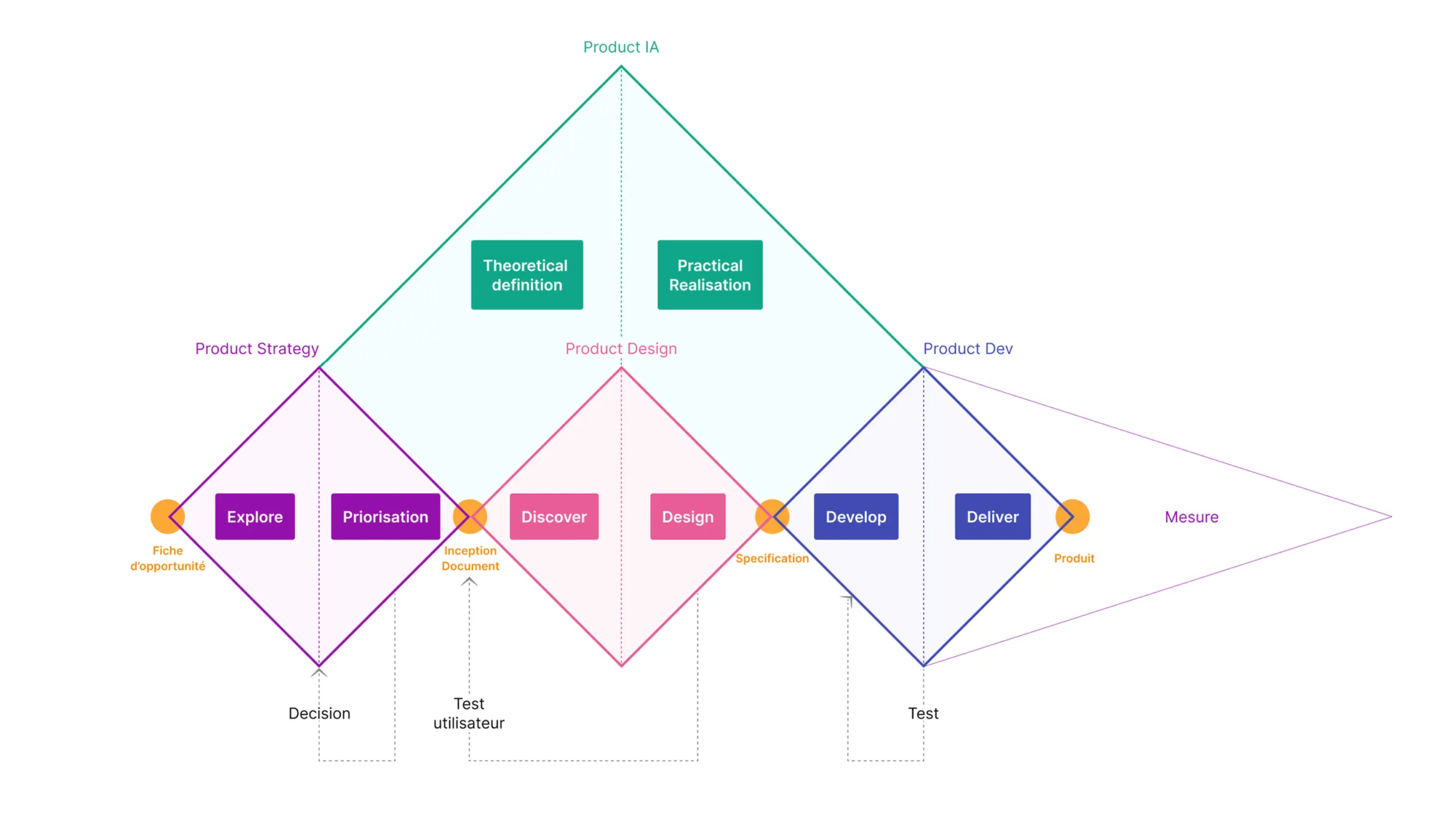
Integrating data and AI into The Innovation Loop’s framework was also designed to resolve the structural friction between the long cycles of scientific research and the speed product delivery demands. To orchestrate this coexistence, I set up a dual-track model, where a track dedicated to “Product AI” runs in parallel with the standard design cycle.
This dedicated space for thinking starts with a pre-scoping phase, whose aim is to “design the concept” before even designing the product. This stage links the business needs expressed by the Product Owner to what the data can actually do, making sure innovation does not remain a mere abstraction. The “Data” route is thus formalised through its own flow, made up of Business Understanding, Data Acquisition and Scenario Specification.
In this framework, the AI team can carry out its “Theoretical definition” and its “Practical Realisation” at its own pace. Synchronisation with the design cycle happens through critical junction points, such as the Inception Document, which serves as a shared container to validate the move into the product design phase. To smooth this cooperation, I introduced AI training for the whole collective, so that designers and developers could understand the constraints of R&D. This approach turns AI, often relegated to a “peripheral function”, into a genuine systemic lever able to design new fields of possibility for the organisation.
Evidence and deliverables
- Macro version of the framework: the “double diamond” diagram including the Explore, Prioritisation, Discover, Design, Develop and Deliver phases, with a dedicated AI overlay.
- Notion dashboard (Discovery + Design): a detailed view listing the drivers, contributors, inputs and outputs for each step of the project.
- User circles Miro: the map of interconnections between the different professions (Marketing, Product Owner, Lead Dev, etc.).
The impact
The framework was validated by the leadership team and the whole collective, becoming the definitive reference for onboarding every newcomer. It made recruitment needs objective by revealing the functions missing from the production chain.
Above all, this mechanism kept strategy and operations perfectly in step, allowing TIL to come through its technical and human scale-up phase smoothly.