Portfolio · Alignment & Coordination
Purpose-driven brands benchmark: reconciling ethics and e-commerce
The in-between space of asserting brand values and the transactional efficiency of e-commerce.
- Role
- Head of Design
- Client
- ïdkids Group (Jacadi, Okaïdi, Oxybul…)
- Deliverables
- Benchmark of purpose-driven brands, reach structure around the e-shop, grid of communication entry points
- Period
- 2019, 12 days of work and 2 days of presentation
- Context
- A document I proposed before leaving the group, presented to brand and marketing directors
The intent
I thought of this document as my legacy within the ïdkids group. The group did not grasp how intertwined the web is: how a brand, its commitments and its e-commerce answer one another from one medium to the next. When I resigned, I offered to work on a document that would make this readable. It was shared with the brand directors and the marketing directors.
The underlying problem: the brands did not see that repetition is what makes an idea stick, nor that users need a space they understand for a commitment to exist in their eyes.
The challenge was therefore to move away from top-down communication and build an reach structure, where commitment (foundation, actions, traceability) flows through the purchase journey instead of sitting beside it.
The mechanics
The challenges
- Consistency: a unified reach narrative for brands with strong identities.
- Connection: linking brand commitment to the sales funnel.
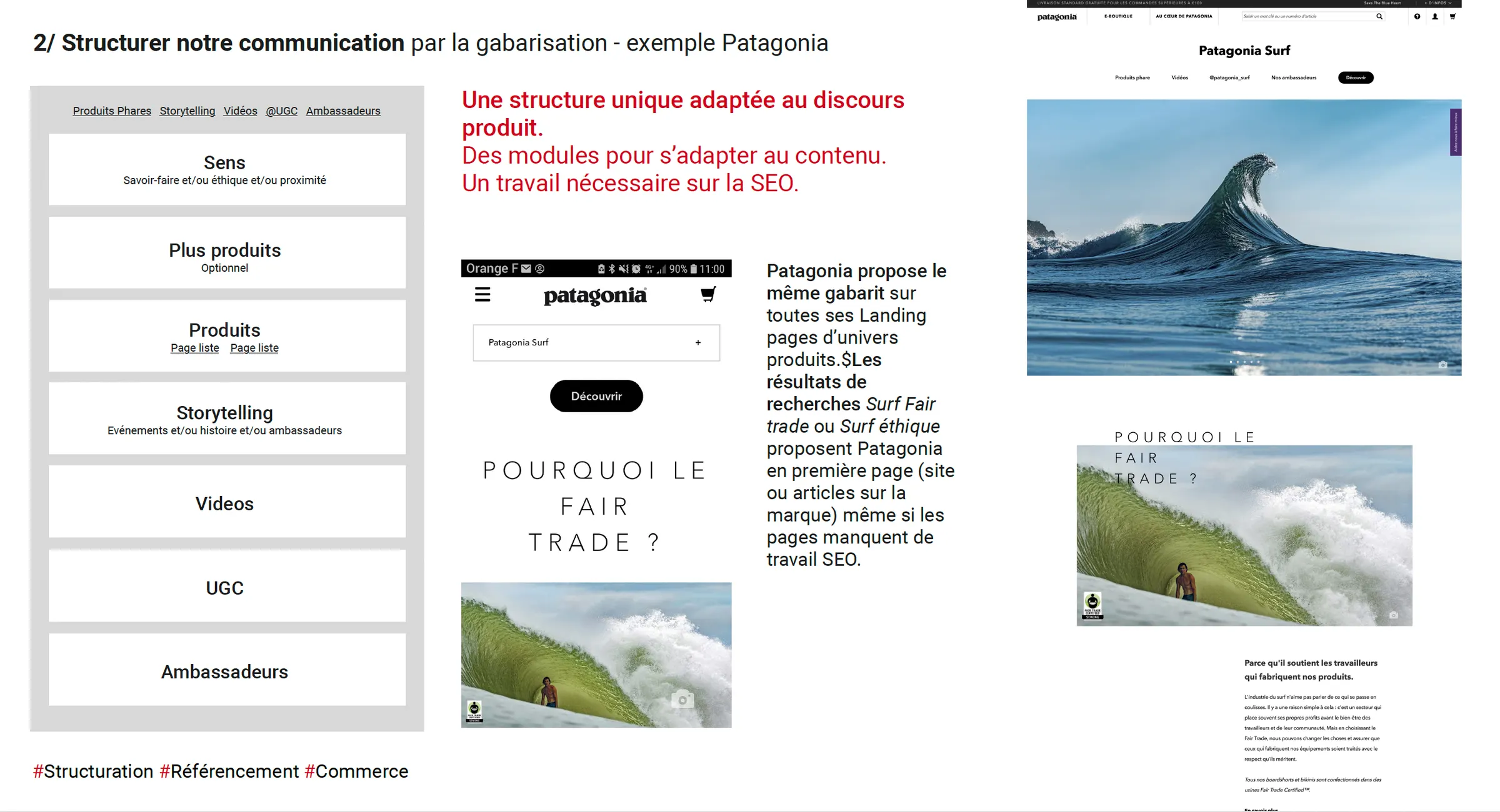
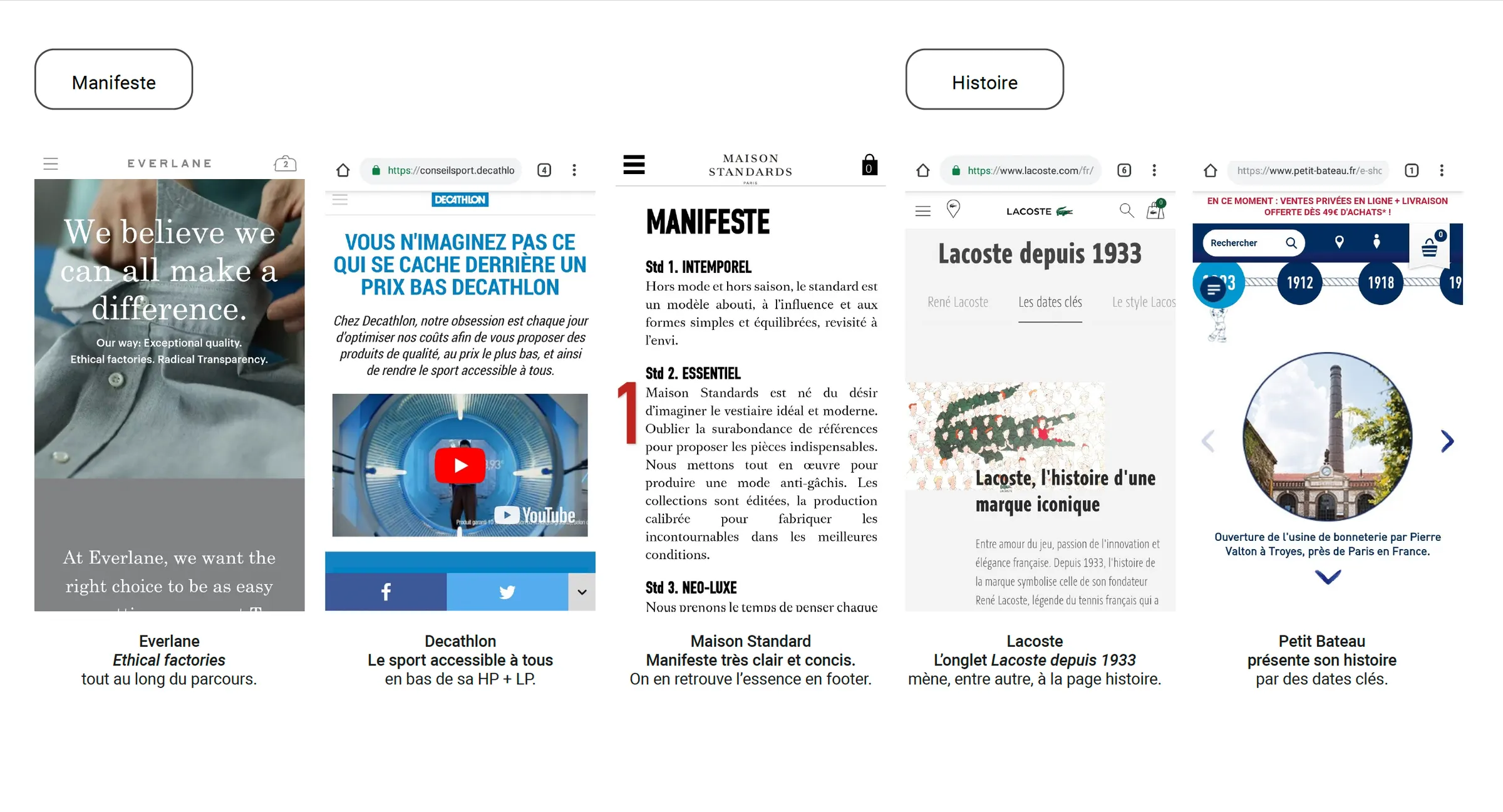
- Templating: a modular structure (manifesto, history, know-how) that can be spread across every medium: home page, e-mail, social media.
The plan
The document was built in 12 days, then presented over 2 days to the brand and marketing teams:
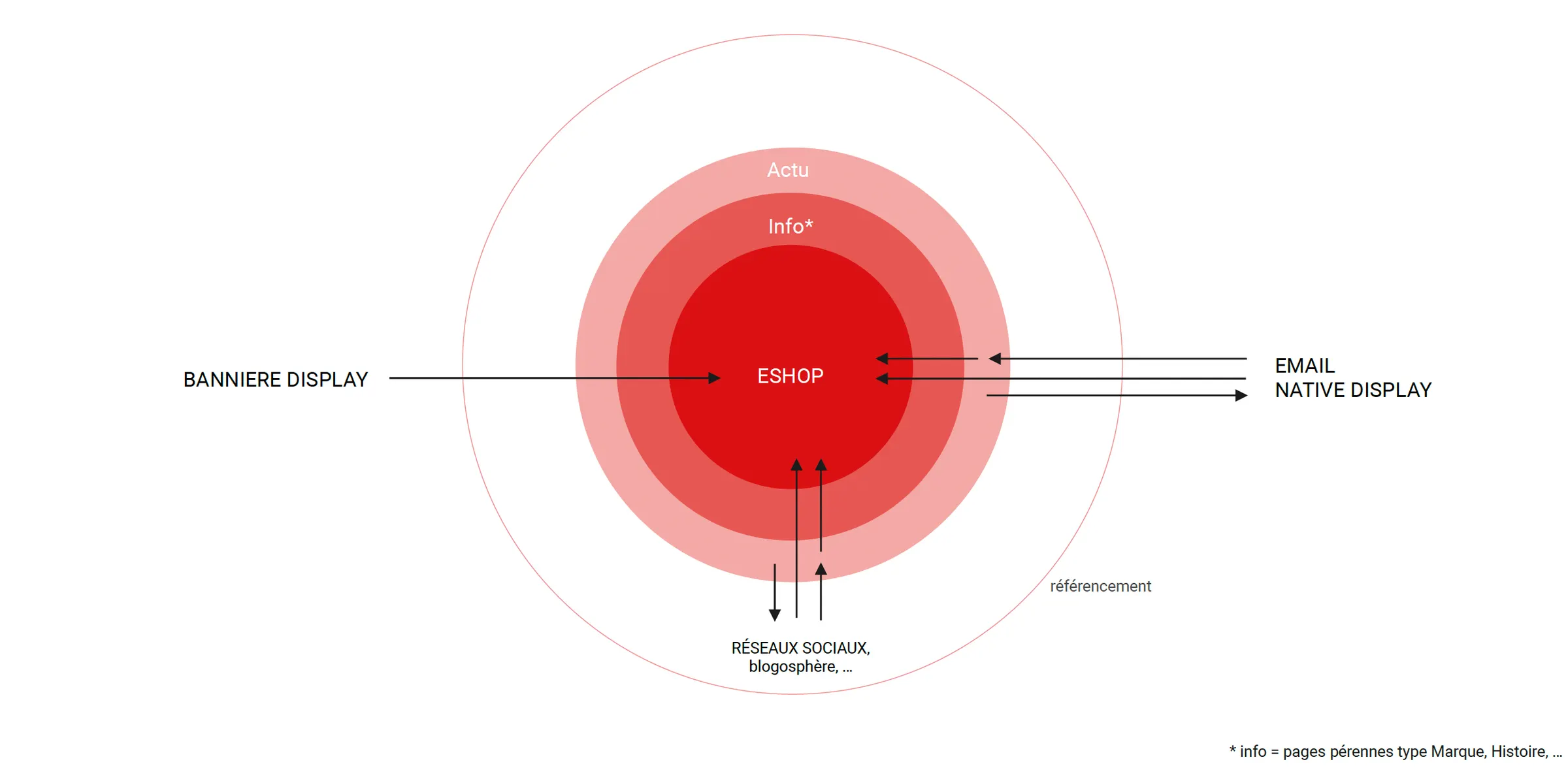
- Reach analysis: a web structure with the e-shop at the centre, surrounded by layers of information (news, evergreen information) and distribution (banners, e-mail, native display).
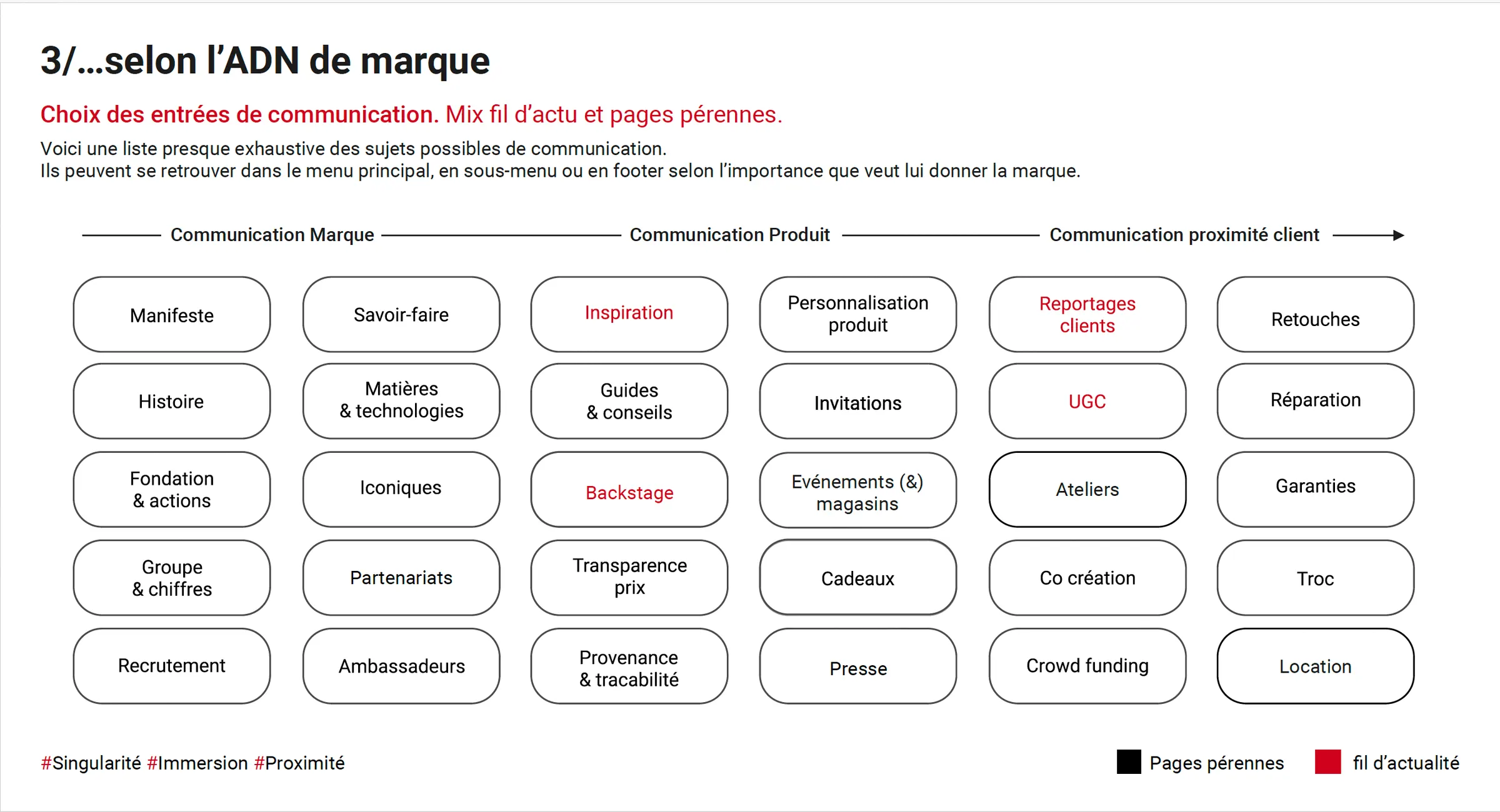
- Content aggregation: the list of possible communication entry points, sorted by type. Brand communication (manifesto, foundation), product communication (origin, price transparency), customer-proximity communication (customer content, swapping, repair).
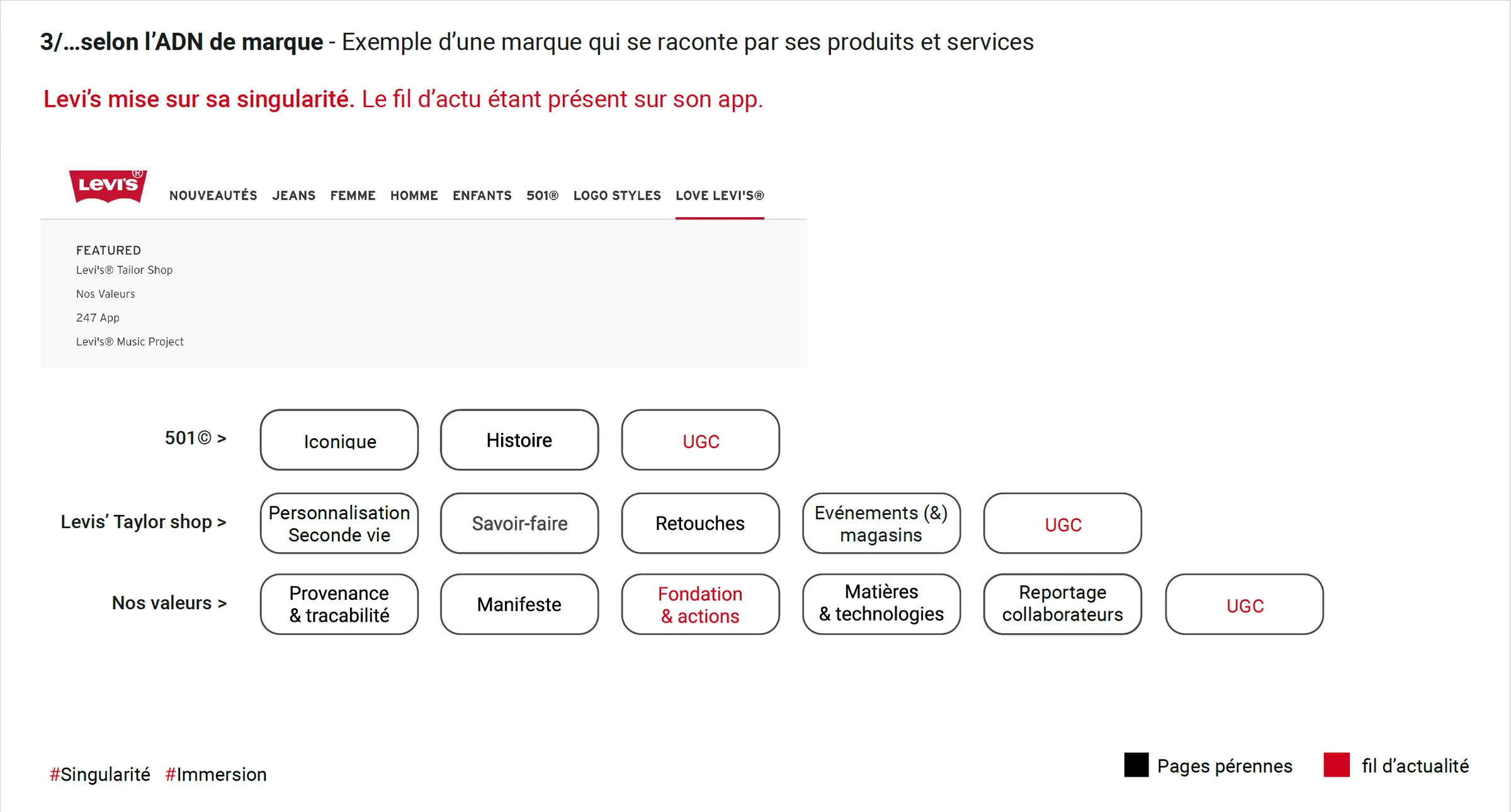
- Benchmark of the leaders: a study of brands known for their commitment, such as Patagonia (1% for the planet), Benetton (diversity in power) or Levi’s (music education), to decode how they communicate.
Evidence and deliverables
- Benchmark of the leaders: the commitments of Patagonia, American Apparel, Benetton, Décathlon and Levi’s, and how each one stages them.
- The reach structure: the diagram of flows between the e-shop and the communication channels.
- The entry-point grid: communication topics sorted between the news feed and evergreen pages.
The impact
The document was shared with the brand and marketing directors. It leaves them a way of reading commitment on the web: one commitment, repeated, placed in a space the user understands, and linked to the purchase.
It also fed another piece of work: the modularity of brand communication.